
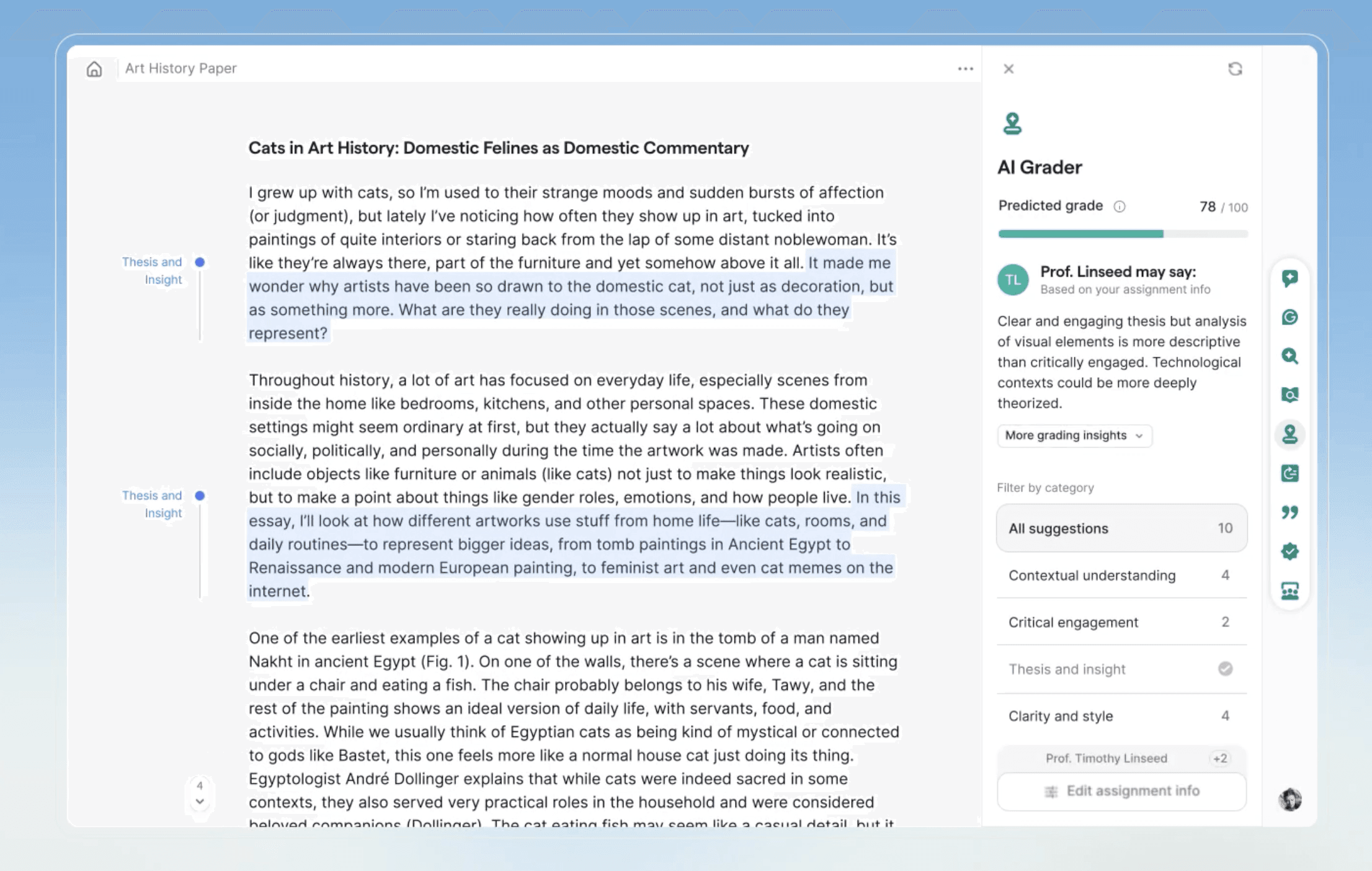
Grammarly, a leading name in writing assistance software, has recently unveiled a suite of eight specialized AI agents designed to enhance educational processes. Among these offerings are tools for grade prediction and plagiarism detection, now available at no additional cost to existing users. This bold move is set to disrupt traditional academic workflows and poses significant questions regarding the integration of artificial intelligence in educational settings.
Challenging the Status Quo
The introduction of these AI agents signifies Grammarly's strategic positioning against its competitors, as it seeks to redefine its role within the academic landscape. By offering advanced tools that can predict grades and identify potential plagiarism, Grammarly is challenging the status quo of educational assessment and integrity. This development is likely to provoke a reevaluation of how educational institutions approach grading and plagiarism, potentially leading to a reliance on AI-driven solutions.
Ethical and Regulatory Concerns
While the technological advancements presented by Grammarly are impressive, they also raise ethical and regulatory concerns. The ability of AI to predict grades could undermine the traditional role of educators in evaluating student performance. Moreover, the deployment of plagiarism detection tools may lead to increased scrutiny and potential misuse, as students and educators alike navigate the complexities of AI-enhanced assessments.
"The introduction of AI agents in education poses significant challenges to traditional academic practices, and without clear guidelines, we risk unforeseen liabilities," warned an educational policy analyst.
Influencing Academic Policy and Practice
Grammarly's latest offerings are not just technological tools; they are potential catalysts for change in academic policy and practice. As these AI agents become more integrated into educational environments, institutions will need to develop comprehensive guidelines to ensure their ethical use. This includes addressing concerns about data privacy, the potential for bias in AI predictions, and the implications of AI-driven decision-making in educational settings.
In conclusion, Grammarly's introduction of AI agents for grade prediction and plagiarism detection is a double-edged sword. While it promises to enhance productivity and streamline academic processes, it also necessitates a careful examination of the ethical and regulatory frameworks governing their use. As educational institutions grapple with these challenges, the role of AI in education will continue to be a topic of critical importance.
Originally published at https://www.techbuzz.ai/articles/grammarly-s-ai-agents-can-now-predict-your-grade
ResearchWize Editorial Insight
Ladies and gentlemen, esteemed educators,
Today, we stand at the precipice of a transformative shift in education, driven by the advent of Grammarly's new AI agents. This development is not just a technological upgrade; it’s a paradigm shift that demands our attention and critical analysis.
Grammarly has introduced a suite of AI tools that promise to revolutionize how we approach grading and plagiarism detection. These tools are now available at no extra cost, signaling a potential upheaval in academic workflows. But what does this mean for students and researchers?
First, let's consider the impact on academic integrity. With AI capable of predicting grades and identifying plagiarism, are we outsourcing our judgment to machines? How will this affect the educator's role in assessing student performance? The potential for AI to alter grading dynamics raises questions about fairness, bias, and the very nature of academic evaluation.
Ethical and regulatory concerns loom large. The deployment of such AI tools could lead to increased scrutiny and potential misuse. Without clear guidelines, we risk unforeseen liabilities. Are educational institutions prepared to navigate these complexities? The introduction of AI in education challenges traditional practices and demands a reevaluation of our ethical frameworks.
Moreover, the integration of AI agents could influence academic policy and practice profoundly. As these tools become embedded in educational environments, institutions must develop comprehensive guidelines to ensure their ethical use. This includes addressing data privacy concerns, potential biases in AI predictions, and the broader implications of AI-driven decision-making.
In conclusion, Grammarly's AI agents are a double-edged sword. They offer the promise of enhanced productivity and streamlined processes but also necessitate a careful examination of the ethical and regulatory frameworks governing their use. As we grapple with these challenges, we must ask ourselves: Are we ready for the AI-driven future of education?
Thank you.
Looking Ahead
Ladies and gentlemen, as we stand on the brink of a new educational era powered by AI, we must ask ourselves: Are we ready for the transformation that's about to unfold?
1. Curriculum Evolution: The curriculum must evolve — and fast. AI literacy should be as fundamental as reading and math. How will our lesson plans change to integrate AI in a way that's both comprehensive and ethical? Schools need to adopt a forward-thinking approach to teach students not just how to use AI, but to understand its underlying principles and implications.
2. Teacher Training: Teachers are the linchpins in this transition. Are they equipped to guide students in an AI-enhanced learning environment? Continuous professional development programs focusing on AI tools and ethical considerations must be prioritized to ensure educators are not left behind in this tech-driven shift.
3. Policy and Regulation: What happens if our regulatory frameworks can't keep pace with AI advancements? We face the risk of significant ethical breaches and privacy violations. Decision-makers must craft robust policies that protect student data and ensure AI tools are used responsibly and transparently in educational settings.
4. Personalized Learning: AI offers the tantalizing promise of personalized learning experiences. But at what cost? We must scrutinize how data is collected and used to tailor educational content. Are we ready to address the potential biases that AI might introduce, thereby reinforcing existing inequalities?
5. Assessment and Integrity: As AI tools like Grammarly's grade prediction become commonplace, how do we redefine academic integrity and assessment? Educators must balance the utility of AI-driven insights with the need for human judgment and creativity in evaluating student performance.
6. Future Skills: The jobs of tomorrow will demand skills that are currently in their infancy. Are we preparing students for roles that don't yet exist? The integration of AI in education should focus on developing critical thinking, creativity, and adaptability — skills that will be invaluable in an AI-dominated world.
In conclusion, the integration of AI in education is not just about adopting new technology; it's about reshaping the very fabric of our educational systems. As we navigate this brave new world, let's commit to ensuring that AI serves as a tool for empowerment rather than a catalyst for division. The future of education is here — are we prepared to embrace it responsibly?
Originally reported by https://www.techbuzz.ai/articles/grammarly-s-ai-agents-can-now-predict-your-grade.
Related Articles
- Google Pledges $5M+ for CS Education, Launches Eye Disease AI Quest
- Major investment in AI – JU part of new research school
- LG Expands Full-time Faculty to Foster AI Graduate School
📌 Take the Next Step with ResearchWize
Want to supercharge your studying with AI? Install the ResearchWize browser extension today and unlock powerful tools for summaries, citations, and research organization.
Not sure yet? Learn more about how ResearchWize helps students succeed.